
Read this before you decline a job on price
If you judge every job only by its fare, you are playing a short game in a network built for the long one. The drivers who earn the most at BDT are not the ones who hold out for the best-paying jobs. They are the ones the network can rely on.
BDT handles more than 1,000 Trip.com bookings a month across Australia, plus work from thousands of other customers. That work is shared across a network of more than 1,000 drivers, and the network is still growing. There is plenty of work to go around. There are also plenty of drivers ready to take any job you pass on.
Every time you decline, the job moves to the next driver in seconds, and the system remembers. The pickier you are, the less you are offered. The less you are offered, the less you earn. Drivers who take their share of everyday work are offered the best jobs, the best pricing and the most of it.
As an independent contractor, you choose which work you take. This article explains how dispatch, pricing and priority work, so you can see exactly what each of those choices costs or earns you.
How a booking gets to you
Every job, whatever its source, lands in one place: the BDT booking platform. From there it is matched to a driver and sent to your driver app.
Bookings come from several places:
- Travel partners such as Trip.com, which sell our transfers to their customers
- Corporate and account clients who book with us directly
- Our own website and quotes handled by the Operations Centre
- Supplier and affiliate work passed to us by other operators
The partner decides nothing about which driver gets the job. They send the booking to us, and our platform decides who is offered it. What the partner does do is judge BDT as a whole on how those jobs go (more on that below), which is why your record matters to everyone in the network.
Our monitoring system, Guardian, does not hand out jobs. It watches bookings after they are assigned and steps in if something looks wrong, for example if a driver has not confirmed they are on the way.
How pricing works
The amount shown on a job offer is what you earn for that job. It is set by the platform before the job reaches you, and it is the same whoever accepts it.
BDT is a private transfer service, not a shuttle. Every fare is priced point to point, per vehicle, not per passenger. The fare is built from a few parts:
- The vehicle category. There are nine categories, from Economy Sedan up to the 11 Seat People Mover. Each step up pays more than the one below it.
- The distance. A starting fee plus a rate per kilometre, set in bands.
- The location. Some areas, such as airports and regional zones, have their own pricing rules.
- The date and time. Public holidays attract a surcharge. Christmas Day, for example, is paid at double.
- The source. Partner work and direct work can be priced differently, because each partner has its own agreed rates. On Trip.com, those rates are shaped by how well the whole BDT team performs (see the Trip.com coefficient, below).
Partners like Trip.com take their own commission out of the customer’s price before anything reaches BDT. BDT’s platform fee then covers the booking system, the Operations Centre, customer support, insurance and everything else that keeps the work coming in. What is left is your fare, and that is the figure on your offer.
Why two similar jobs can pay differently
Two trips that look alike on the map can come from different partners, fall in different pricing zones, or be booked in different vehicle categories. That is normal, and it is why comparing fares with another driver rarely tells the whole story.
When an offer price goes up
Sometimes we raise the offer on a job that has not been picked up, so the customer is not left stranded. In a lot of cases that extra money comes out of BDT’s own pocket and we make nothing on the job. It is a safety net for the customer, not a new going rate. Declining the job at its normal price still counts against your acceptance rate, so waiting for a top-up is a losing strategy (see Common myths below).
How dispatch works
Each job is offered to one driver at a time, starting with the best fit, and moves down the line until someone accepts it.
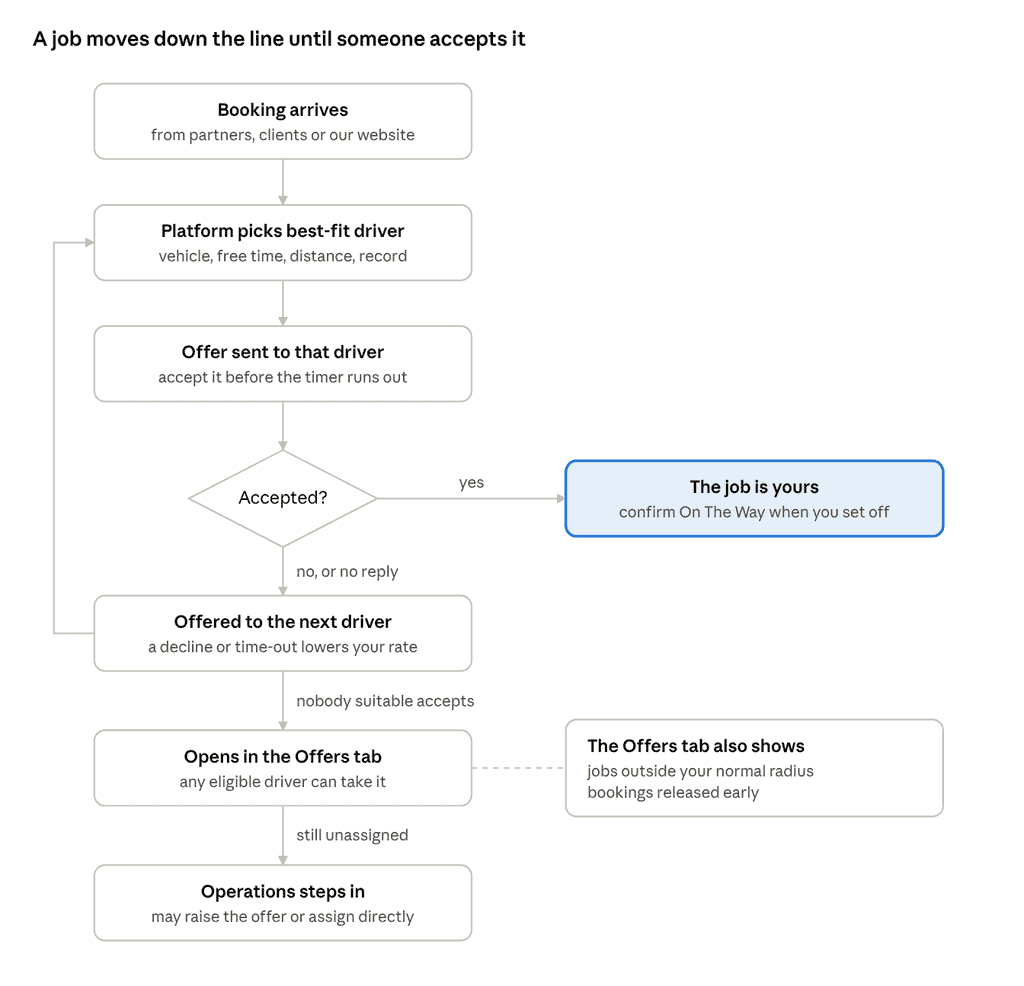
When a booking comes in, the platform looks for the driver best placed to do it: the right vehicle, free at the right time, close enough to get there comfortably, and with a record that says they will turn up. That driver gets the offer first. If they accept, the job is theirs. If they decline or let the timer run out, it moves to the next driver in line, and so on.
This is why accepting quickly matters. A job does not sit and wait for you, and letting an offer time out counts the same as declining it.
The Offers tab (Marketplace)
The Offers tab is where jobs sit that are open to any eligible driver. It holds three kinds of work:
- Jobs that nobody accepted when they were offered one at a time
- Jobs outside your normal area or radius, which you can choose to take on
- Bookings released early, well ahead of the pickup date
The Offers tab is a privilege, not a right. Drivers with a consistently low acceptance rate may have it switched off. If that happens you still receive jobs sent directly to you, and any bookings you have already accepted are not affected.
How our smart dispatch engine decides
Our booking platform uses an AI-powered dispatch engine that learns from past jobs. When it decides who to offer a job to, it weighs up:
- Your acceptance and cancellation rates. Drivers who accept and keep their jobs are trusted with more.
- Your ratings and driver profile. Customer feedback and your history on the platform both count.
- Your idle time. How long you have been waiting since your last job, so work is spread evenly among drivers who are waiting. If you go offline, that waiting time resets.
- Your upcoming bookings. It checks for overlaps with jobs you already hold, and whether a new job fits in before your next booked pickup.
- Back-to-back planning. It looks at where your current job drops off, so your next pickup lines up sensibly.
- Vehicle and driver attributes. Jobs that need something specific (a vehicle type, a language, a feature) only go to drivers and vehicles that have it.
- Restricted zones. Some locations need special permits or approval. Only authorised drivers are offered jobs there.
The exact weighting of each factor is not published, and it changes as the engine learns. On top of it, BDT sets its own rules about who is offered higher-paying and VIP work first, explained in the next section.
Other dispatch features you will notice
- Job reminders by SMS. Your job link is sent to you automatically a set time before pickup.
- Automatic re-dispatch. If the assigned driver has not started the job on time, the system can reassign it to someone else without waiting for a dispatcher.
- Group offers. Some jobs are sent to several eligible drivers at once, and the first to accept gets it.
- Customer privacy. Customer details stay hidden until you accept or start the job.
- Everything is logged. GPS tracking and the dispatch log record every status update, assignment and change, and who made it. These logs are what we check when a job is disputed.
- Removed means removed. If you are taken off a job, you stop getting notifications for it.
Who gets priority, and why
The better paying and VIP work goes first to drivers who accept consistently and do the job well. Everyone gets work, but the best work goes to the most reliable drivers.
| What we look at | What it means | Why it matters |
|---|---|---|
| Acceptance rate | How often you accept the jobs offered to you. Declines and time-outs both lower it. | Higher paying work is offered first to drivers with the highest acceptance rates. |
| Top Driver status | Earned over time by drivers who are reliable team players. | Unlocks VIP and priority bookings, better pricing, lower commission and advance allocations. |
| Reliability record | Confirming On The Way on time, arriving on time, no recalls, no no-shows, honest status updates. | A job offered to an unreliable driver puts the customer and our partner ranking at risk. |
| Vehicle category | The category your vehicle is registered in. | You are only offered jobs your vehicle is eligible for. |
| Availability and location | Whether you are free at the pickup time and close enough to get there comfortably. | Covered further down this article. |
Why acceptance rate carries so much weight
In 2026 we began enforcing acceptance rates. The aim is simple: stop cherry picking. When a driver only takes the best jobs and leaves the rest, those other jobs still have to be done, often at extra cost to BDT and sometimes too late for the customer. Drivers who take a fair share of the work are rewarded with the pick of the better jobs. Drivers who consistently decline get offered less, and may lose access to the Offers tab or, in serious cases, the platform.
The Trip.com coefficient: why one driver affects everyone
Trip.com scores every supplier in every city and turns that score into a coefficient, a multiplier that decides how BDT is treated on their platform. It affects how many bookings we are sent, how prominently our prices are shown to customers, and whether we can negotiate higher rates.
The score is built from the whole team’s results in that city:
- Late arrivals and no-shows
- How quickly bookings are confirmed and drivers set off
- How quickly customer messages are answered
- Whether procedures are followed on every job
- Customer ratings
A strong coefficient means more jobs and puts BDT in a position to push for price increases, which flow through to driver fares. A weak coefficient means fewer jobs, less visibility, and price increases taken off the table.
This is a team score. Every driver in a city shares it. One or two drivers who run late, don’t turn up or ignore procedures can drag the whole city’s coefficient down, and every other driver there pays for it in fewer jobs and flat fares. It is the main reason we take reliability so seriously, and why the drivers who protect the team score are the ones we reward.
What top performers get
We reward the drivers who consistently accept, turn up on time and follow procedures. Top performing drivers are given:
- Better pricing on the jobs they are offered
- Lower commissions, so more of each fare stays with them
- Higher earnings overall, from both of the above and a steadier flow of work
- VIP and priority bookings, offered to them before anyone else
- Advance allocations, with jobs assigned well ahead of time so they can plan their weeks with confidence
None of this is handed out by seniority or who you know. It is earned, and kept, through your record on the road.
The long game: why pricing is a team effort
Fares go up when the whole network earns it over time, not when one driver has a good week or complains about a price. Your fare is shaped by how every BDT driver in your city performs, month after month.

How prices actually go up
BDT can only ask Trip.com and our other partners for higher rates when we can prove, over months, that we are one of their most reliable suppliers. Partners look at long-run results, not a single good week. A run of strong months builds our case. One bad week of late arrivals and no-shows can undo it.
That is the long game. The reliable work you do today is what gives us the leverage to raise prices tomorrow, for you and for everyone else in your city.
Why declining low fares backfires
When a driver declines a job because the fare looks low, one of two things happens. Either the job goes uncovered and the city score takes a hit, or BDT tops the fare up out of its own pocket to get it covered. Either way, the money and the leverage we need to push prices up both shrink.
So cherry picking today means lower fares tomorrow. The drivers who take their fair share of everyday work are the ones building the case for better pay across the network.
It also costs you directly. With more than 1,000 drivers in the network, nobody is short of someone to offer the next job to. A driver who keeps declining on price quietly drops down the line, while drivers who accept steadily move up it and collect the better paying work.
Your solo record is only half the picture
It is easy to think: “I’m always on time, so why aren’t my fares going up?” Your own record decides which jobs you are offered and what rewards you get. But the price of the work itself is set by the whole team’s record. One or two unreliable drivers in a city can hold back fares for every good driver there.
That is why we act on poor performance, and why we ask good drivers to take pride in the team score, not just their own.
A real example
Recently a partner removed a cheaper operator in one of our cities for poor performance, and asked BDT to take over its bookings. That is the long game paying off. Reliability won us the work, and more work is exactly what gives us room to negotiate better rates. The drivers who step up and take those jobs are the ones who will benefit most when it does.
Operations looks after Top Drivers too
A strong record does not only count with the dispatch engine. Our Operations team knows who the Top Drivers are, and they are shown priority and leniency to match:
- They are the first people Operations calls when premium, VIP or hand-picked jobs need a driver
- When something genuinely goes wrong, such as an accident or a closed road, a driver with a strong record gets the benefit of the doubt
- They get the most flexibility when jobs need to be juggled or rescheduled
Drivers with a patchy record should expect less of that flexibility. It is not personal. Trust is built on the road, and Operations can only lean on the drivers who have shown they can be relied on.
Distance to pickup, free time and availability
The platform will only offer you a job it thinks you can reach on time, around the jobs you already have. Where you are and when you are free are checked before your record even comes into it.
Your free time between jobs
Most BDT work is booked ahead, not on demand. So the platform looks at your schedule as a whole. If you already have a job that finishes near the new pickup time, it allows for where that job drops off and how long it takes to get from there to the next pickup. If the gap is too tight, you will not be offered the job, even if you are the closest driver right now.
Remember to allow for waiting time. On Trip.com airport pickups you get up to 60 minutes of waiting time from the booked pickup time, not the flight landing time. A job straight after an airport pickup has to allow for that full hour.
Distance to the pickup
Fares are priced on the trip itself, from pickup to drop-off. Getting to the pickup is part of your own planning, which is why the platform favours drivers who are already nearby or whose last job finishes close by. It is also why accepting a job an hour’s drive away, then arriving late, does nobody any favours.
Jobs outside your usual area still show up in the Offers tab. You can choose to take them, as long as you can get there on time.
Idle time and staying online
Our dispatch engine considers how long each driver has been waiting since their last job, and tries to spread work evenly among drivers who are waiting. If you go offline, that waiting time resets. Staying online and available when you want work helps you, and logging off and on again does not move you up the queue.
Quiet weeks happen
Pre-booked premium transport goes up and down with travel seasons, school holidays, events and flight schedules. A drop in work for a few days is usually normal demand, not a problem with your account. If your acceptance and reliability are good, the work comes back as demand picks up.
What lowers your priority
Anything that makes a job less certain to go well moves you down the line. Most of these are recorded automatically, so they count whether or not anyone contacts you about them.
| What happens | How it affects you |
|---|---|
| Declining offers, or letting them time out | Lowers your acceptance rate. You are offered fewer jobs, and the better paying ones go to others first. |
| Recalling or handing back a job you accepted | Counts as a cancellation, which the engine weighs heavily. The job has to be re-dispatched, often at short notice. |
| Accepting a job without reading it properly | Usually ends in a recall. Check the date, time, pickup, vehicle and notes before you tap accept. |
| Not confirming On The Way in time | Our monitoring system escalates the job and may re-dispatch it. A re-dispatched job is not handed back. |
| Arriving late | Hurts the customer, our partner ranking, and your own record. |
| Marking yourself arrived or completed when you are not | GPS and the dispatch log show where you actually were. False status updates are treated seriously. |
| No-shows | The most serious of all. Expect penalties under your Driver Service Level Agreement and possible removal. |
| Passing a job to another driver without approval | Not permitted. Every job must be done by the driver and vehicle it was assigned to. |
| Poor customer ratings | Feed straight into the engine’s view of your profile. |
The consequences build up. It usually starts with fewer offers, then losing priority access, the Offers tab or Top Driver status. Repeated or serious issues are handled under the penalty framework in your Driver Service Level Agreement, and you always keep your right to dispute a decision through the process set out there.
How to get more and better jobs
The drivers who get the most work are not the ones who wait for the perfect job. They are the ones the system can count on.
- Accept what you can do, and do what you accept. A steady acceptance rate does more for your earnings than any single job.
- Respond to offers quickly. A time-out counts the same as a decline. Keep notifications on while you are available.
- Read the whole job before accepting. Date, time, pickup, drop-off, vehicle, passenger numbers and notes.
- Keep your schedule realistic. Leave room for traffic and for the full waiting time on airport pickups.
- Stay online when you want work. Your idle time counts towards your place in line, and going offline resets it.
- Confirm On The Way on time, every time. It keeps the job safely yours.
- Be early, not just on time. Punctuality protects your record and the city’s partner ranking.
- Keep your statuses honest. Arrived means at the pickup. Completed means the passenger has been dropped off.
- Take the direct, fastest route. If a detour is genuinely needed because of congestion, an accident or a delay, be ready to show why.
- Keep your vehicle and profile details up to date. The engine can only match you to jobs it knows your vehicle is eligible for.
Common myths and questions
“There’s so much work, I can afford to be picky.”
There is a lot of work, but it is shared across more than 1,000 drivers. A job you decline is gone to someone else within seconds. Each decline also tells the system you are less likely to accept next time, so you are offered less. Over a few months, picky drivers see their work dry up, while drivers who accept steadily pick up what they left behind.
“If I decline, the price will go up.”
Sometimes it does, because we would rather lose money than leave a customer stranded. But every decline at the normal price is recorded against your acceptance rate. The drivers who hold out for top-ups end up offered less work overall, and they are the last to be offered the better jobs.
“My mate gets more jobs than me, so the system must favour him.”
The system favours reliability, location and availability, not people. Your mate may be in a busier area, free at different times, in a different vehicle category, or simply accepting more of what he is offered.
“My work dropped off this week, so something must be wrong with my account.”
Usually not. Pre-booked work rises and falls with travel seasons, events and flight schedules. If your acceptance and reliability are good, the work comes back as demand does.
“Logging off and back on puts me at the front of the queue.”
The opposite. Going offline resets your idle time, which can move you further back.
“The travel partner picks which driver gets the job.”
No. Partners send bookings to BDT, and our platform decides who is offered them. Partners judge BDT as a whole on how those jobs go.
“I missed an offer. Can Operations give it back to me?”
No. Once an offer moves on, it belongs to the next driver in line. Our phone lines and inboxes are there for problems on jobs, not for missed offers.
“Why don’t I have the Offers tab?”
The Offers tab is available at BDT’s discretion and can be switched off for drivers with a low acceptance rate. You still receive jobs sent directly to you. Improving your acceptance rate is the way to get it back.
Need help on a job?
Call the Operations Centre on 1300 258 847, 24 hours a day, for any problem on a job you have accepted: running late, can’t find the passenger, a change to the booking, or anything that puts the job at risk.
All changes to bookings go through Operations. Drivers cannot edit, change or create bookings, and passengers should be referred to Operations rather than given your personal contact details.